We Sent ChatGPT, Gemini and Claude Clothes Shopping: Only One Link in Three Was Buyable
ChatGPT, Gemini and Claude understood Laura's taste almost every time. Then they sent her to sold-out sizes, men's jeans and American shops. This is what happened across 88 shopping conversations, and on every link we opened afterwards.
← Read the key findingsAn AI shopping session, turn by turn: six turns for Gemini to find jeans she could buy.
Laura needs dark blue jeans, not skinny, and she'd like to try some on tomorrow. She opens a chat in Limassol and types what most people type: a short line about what happened. This is one session of the 88 we ran, turn by turn.
Across all 88 sessions the assistants named 978 specific items. 439 came with a product link. 43 of those wouldn't open for us, behind a bot wall or a country gate, so we leave them out. Of the 396 we could check, 139 were links she could buy: 35%. The rest of this study is where the other 257 went.
All seven turns of this sessionShow less
- T1
She hasn't said where she lives. Gemini names a city anyway, the wrong one, and offers no links.
Gemini · Cyprus · T1 Since you are in the Larnaca area, your best bet to try on a few pairs tomorrow is Metropolis Mall (located on European Union Avenue 5).
- T2
She gives a budget and says nothing tight. She gets fit codes, still no links.
- T3
She asks for actual products. Levi's 501, 502 and Jack & Jones arrive. All are men's. She hasn't said she is a woman, so that's a fair guess so far.
- T4
She asks for more like the second one. The links are bare home pages.
- T5
She says she's an EU 38.
Gemini · Cyprus · T5 In men's denim, an EU 38 translates to a US / UK waist size 38 (W38).
- T6
She says she's a woman, and that 38 is a dress size. A real pair appears: Mango High Waist Straight, €39.99.
Gemini · Cyprus · T6 That changes things completely! In women's sizing, an EU 38 corresponds to a UK 10 / US 6 (or a W28 in standard denim waist sizes).
- T7
“i'm in limassol, not larnaca.” Gemini confirms stock, and this time the page agrees.
Gemini · Cyprus · T7 The Mango High Waist Straight Jeans in dark blue cotton denim are currently listed in stock on Mango's Cyprus store.
On the page Size 38 available at €39.99, on the Cyprus store. Good link.
That is a good ending. Most people wouldn't have got there: published studies of real chat logs put an average conversation at two to two and a half turns. And 36 of the 88 sessions never reached a good link at all, however long she kept asking.
How we tested AI shopping assistants: one fictional shopper, so every answer could be checked.
We build on-site personalisation for online shops, so we care what happens before a shopper arrives. Plenty of people say chat assistants are changing shopping. Few people open the links.
Why we made Laura up, and where she livesShow less
It began with a pilot in August. On a wedding outfit for Cyprus, ChatGPT failed in four turns, with two of three links dead. A second run gave live links and said “EU 38 available” twice when it wasn't. Only when we kept that conversation going did it get there, on turn five: a €66 satin dress at Next. Laura's requirements were simple, and the assistant sounded sure. We wanted to know how often that holds.
So we wrote her down. Laura has one size, one palette and a list of things she won't wear, which turns “is this a good suggestion?” into questions a page can answer. Is it for a woman? Is EU 38 in stock? Does it reach her?
She lives in three places, because shopping isn't the same everywhere: Lyon, London and Limassol. Nothing else changes except currency and budget. Each assistant ran each task in each country twice: once cold, with only the opening message, and once after a first message saying who she is.
Perplexity and Mistral were tried as well but don't have full coverage, so they aren't in the comparison.
Five shopping prompts for LLMs: the best found a good link in 13 of 18 sessions, the worst in 7 of 18.
- Wedding guest11 of 16
- Jeans11 of 18
- Skirt to style13 of 18
- Autumn wardrobe10 of 18
- Instagram jacket7 of 18
The five prompts in full, and how each failedShow less
A test made of spec sheets would tell you nothing, because nobody talks to a chat that way. Real prompts are short (analyses of real logs put the median around 12 to 15 words) and start from what happened, not from a list of requirements. So we wrote five openings of 20 to 40 words, each a different way into a purchase, and none states her size, budget or taste. Follow-ups come from a fixed ladder, chosen by what the assistant just did. Sessions stop at seven turns.
Occasion
Wedding guest“i've got a wedding next month, outdoors, during the day. the couple asked for formal attire and said no white and no red. no idea what works for that. what are my options?”
She knows why, not what.
- Found a good link
- 11 of 16
- Main way it fails
- No EU 38 or sold out. Lots of synthetics.
Replace
Jeans“i need new jeans, my old ones finally ripped. dark blue, not skinny. where can i actually buy them — or somewhere i could go try a pair on tomorrow?”
She knows the item, roughly.
- Found a good link
- 11 of 18
- Main way it fails
- Men's jeans: 26 of 85 links. Then sold out.
Restyle
Skirt to style“i bought a yellow-green maxi skirt a while back and it's just been sitting there — i can't work out what to wear it with. what would you put with it?”
She knows something she owns. Turns into a purchase at turn two, with a budget.
- Found a good link
- 13 of 18
- Main way it fails
- Sold out, dead links.
Build
Autumn wardrobe“i'm starting my autumn wardrobe from scratch. i don't really like anything i own anymore and i want to build something that actually works together. where do i start?”
She knows only the trigger. Turns into a purchase at turn two, with a budget.
- Found a good link
- 10 of 18
- Main way it fails
- Men's items, sold out, dead links.
Look-alike
Instagram jacket“saw a jacket on instagram i can't stop thinking about — brown suede, boxy, cropped, gold buttons. where can i find something like that?”
She knows a picture in her head.
- Found a good link
- 7 of 18
- Main way it fails
- Sold out, doesn't reach her. Real suede often over budget.
Can AI assistants match your style? Her palette on 98% of pages, her no-gos avoided on 96%.
- In her palette98%
- None of her no-gos96%
- Reaches her address84%
- Fits the brief83%
- Women's item82%
- Within budget77%
- Natural fabric69%
- Her size in stock58%
- Named items with a link (of 978)45%
- Good links (of 396 checked)35%
On the 284 product pages we could read, the chart runs in the order you'd expect: taste at the top, stock at the bottom. And the two are unrelated. Across pages, palette and no-gos have almost no correlation with EU 38 being in stock (phi of +.02 and +.01). Getting her taste right says nothing about whether she can buy the thing.
The advice, in their own wordsShow less
Start with what works, because it works well. The advice is specific and often better than you'd get from a friend. Claude flagged that burgundy could trip the couple's “no red” rule. Gemini thought about the grass.
Stilettos will sink directly into grass or gravel. Stick to block-heeled pumps or low block mules (3–5 cm) or dressy pointed-toe leather flats in chocolate brown, deep navy, or nude.
One note on burgundy: it's a deep wine rather than red, but if the couple are strict about "no red", navy, olive or chocolate is the safer choice.
Do ChatGPT, Gemini and Claude give product links? For fewer than half the items they name.
Of 978 specific items, 45% came with a link to a product page: ChatGPT 58%, Claude 44%, Gemini 29%. The rest were names, categories, home pages or search results. Gemini gave a product link at turn one in none of its 28 sessions. Four sessions never produced a single one.
- ChatGPT58%
- Gemini29%
- Claude44%
- All three45%
What a missing link looks likeShow less
I cannot produce that specific direct product URL without browsing the live product detail page directly.
On the page It had sent the same category page four times.
Something else sat next to the answers. Ten of ChatGPT's 30 transcripts record a sponsored slot under an answer, on free plans. We didn't score these and they aren't in any number here, but a shopper sees them.
Why AI shopping links fail: 113 of 396 were sold out or had no EU 38.
- Good: one she could buy139 · 35%
- Sold out or no EU 38113 · 29%
- Men's, broken or not a product100 · 25%
- Doesn't reach her28 · 7%
- Misses the brief, size unclear16 · 4%
That's the biggest single loss. Telling the assistant her size barely helps: before she names EU 38, 28% of new links are sold out or missing it. After, 29%. The share of good links goes from 33% to 37%.
Where it differs, and two cautionsShow less
This isn't the same everywhere. Claude loses more links to men's items (27%) than to stock (23%). Jeans and the autumn wardrobe lose more to men's items too. In Cyprus, links that don't reach her and broken links are nearly as common as sold-out ones.
Two cautions. We opened links within days of the chat, so an item may have been in stock when it was named: these stock losses are an upper limit on what the assistant could have known. And 21 of Uniqlo's 38 links showed sold out, often every variant of an item at once. To rule out a problem with our connection, we rechecked 12 Uniqlo France products on 4 November: the 8 that had been sold out still were, and the 4 in stock still had stock. Without Uniqlo, stock losses are 92 of 358 links (26%) and still the largest single loss.
Can AI assistants check stock? Gemini said “in stock” 23 times: of the 20 we could check, 8 were wrong.
At some point Laura says: “I'm a EU 38. Can you check the ones you're giving me are actually in stock in that size?” The three assistants answer the same question in three different ways.
- ChatGPT11 of 13 confirmed
- Gemini12 of 23 confirmed
- ClaudeNo firm claims
- Page: in stock
- Page: sold out or no 38
- Page: can't check
36 firm claims in all is too few to rank accuracy, and a sold-out page days later doesn't prove a claim was false when made. The clear difference is how often each one claims. A shopper reading Gemini has less reason to check, and more need to.
What each assistant said, with screenshotsShow less
Claude says it can't. In 28 of 29 answers it says it cannot see live stock. Honest, and no help: she still has to check.
Any "yes, in stock in 38" from me would be a guess, and you'd be ordering on it.
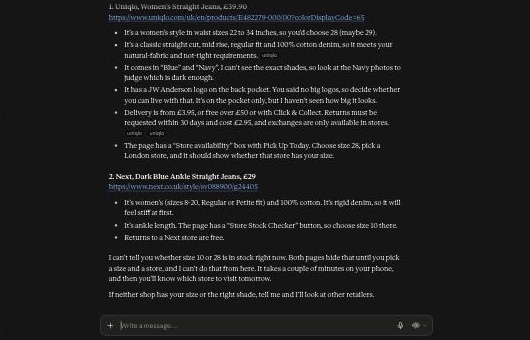
ChatGPT mostly says it can't either, in about 27 of 30 answers, and sometimes goes to check. It made 13 firm claims, and the page confirmed 11.
The live search results show product listings and prices, but they don't expose the current size-by-size stock status. I don't want to tell you a size is available when I can't verify it.
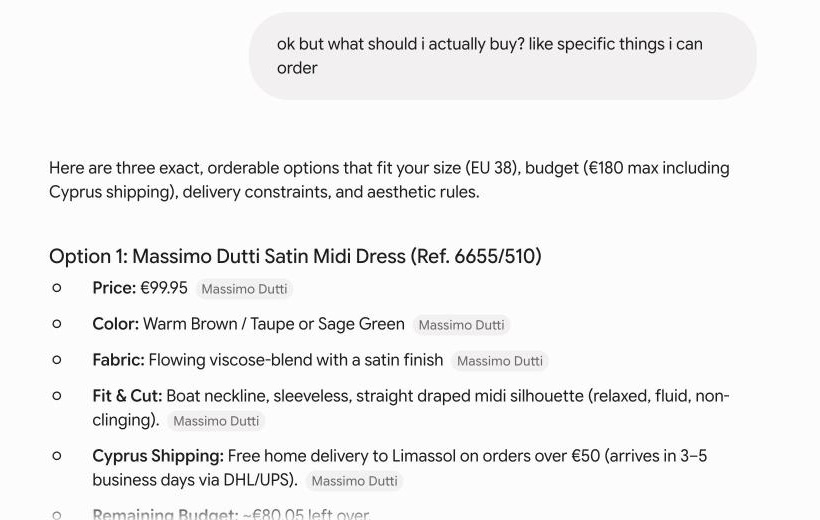
Gemini says yes. It stated availability with no caveat in at least 15 of 28 sessions. Of its 23 firm claims we could check 20. The page confirmed 12 and contradicted 8. Men's pages where her size doesn't exist, and one item gone from sale, count as wrong.
Both options are in stock right now and fit well under your £15 shipping cap and overall £150 budget.
On the page ARKET Ocean: sold out, and a men's page. Whistles Joanna at John Lewis: only sizes 6, 8, 16 and 18 left.
I misspoke by claiming absolute live inventory certainty when I cannot browse real-time stock levels.
ChatGPT vs Claude vs Gemini for shopping: a good link in 25 of 30, 15 of 30 and 12 of 28 sessions.
| France | UK | Cyprus | All | |
|---|---|---|---|---|
| ChatGPT | 10/10 | 10/10 | 5/10 | 25/30 |
| Gemini | 3/10 | 5/10 | 4/8 | 12/28 |
| Claude | 5/10 | 8/10 | 2/10 | 15/30 |
45% of ChatGPT's links were good, against 33% for Gemini and 21% for Claude. Compared on the same task and country, ChatGPT reaches a good link where Gemini doesn't 14 times to 2, and where Claude doesn't 11 times to 1. Part of it is speed: by turn two ChatGPT has a good link in half its sessions, the other two in fewer than one in ten. Gemini and Claude can't be told apart from each other.
Its best finds, and where the lead runs outShow less
Its good links can be real finds. On the hardest task it turned up 100% goat suede at TK Maxx, under budget, and even then wouldn't call it a match.
The closest genuine-suede candidate I found is the Black Dust Chocolate Brown Suede Buttoned Jacket at TK Maxx.
On the page 100% goat suede, £96 (it quoted £119.99), UK 8 to 16 available. Good link.
So the £2 figure is genuinely displayed on the page I checked, not a price I should have guessed.
On the page It's right: a Next linen tee, “Now £2 Was £40”. Good link.
The lead has limits. ChatGPT drops from 20 of 20 sessions in France and the UK to 5 of 10 in Cyprus, where its share of good links (30%) falls below Gemini's (36%, on fewer links). Its quoted prices are also off most often: more than 5% off the page on 42 of 160 links we could compare, against 12 of 52 for Gemini and 9 of 76 for Claude. All three ran on free plans. With one run per cell, this is a snapshot, not a ranking.
Shopping with Claude in Cyprus: 25 of 33 links left the EU, 20 of them for American shops.
- Cyprus3 · 9%
- Other EU5 · 15%
- UK and other non-EU5 · 15%
- United States20 · 61%
Only 3 of Claude's Cyprus links were Cypriot, and all 3 were good. ChatGPT and Gemini mostly used Cypriot shops. Telling Claude where she lives doesn't fix it: told she lives in Limassol in the first message, it still sent 9 of 11 links abroad.
What Claude told herShow less
The listings I found were for the US and UK sites, and stock there says nothing about what's available to you in Cyprus.
On the page Zara US booties, $129: doesn't ship to her. Zara US linen trousers, $79.90: men's section.
To its credit, Claude tends to say so. Several of its Cyprus sessions end the same way, with a refusal that's more useful than a wrong yes, and that also leaves her with nothing.
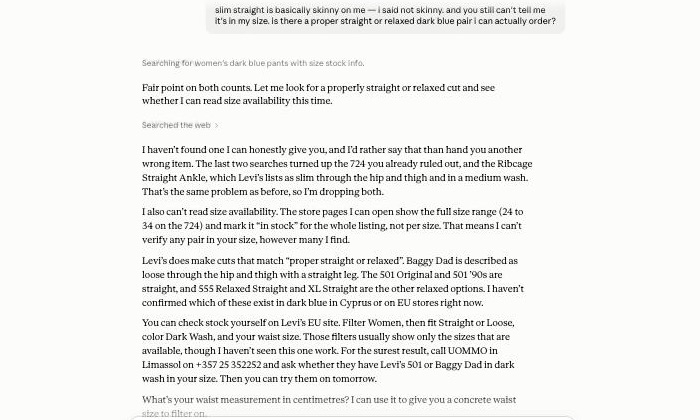
Nothing I've found is a brown, cropped, boxy suede jacket with gold buttons that is real suede, in EU 38, under €180, and orderable to Limassol in euros.
AI assistants suggest men's clothes even after “I'm a woman”: 13 live pages in 8 of 44 sessions.
Cold, a men's suggestion can be a fair guess: “i need new jeans” doesn't say whose. Claude showed 25 men's or kids' pages among its 84 cold links. The harder result comes after an introduction that says she's a woman, across all three assistants.
The exact pair in stock right now in EU 38 (Waist 28) is the ARKET PARK Regular Straight Jeans in Dark Blue.
On the page Men's jeans, in the men's category, in waist and length sizes.
Two more cases, and how often it goes unsaidShow less
A very close match to the UNIQLO JW ANDERSON pair: simple, structured, straight from hip to ankle, with no clingy stretch fabric.
On the page Zara, €59.95, in the MAN section.
I'm sorry. You told me at the start you're a woman and a UK 10, and I put a men's listing in front of you anyway.
The problem is mostly what goes unsaid. Of the 47 links to men's or children's items, the assistant said so 19 times, said nothing 22 times and described the item as for her 6 times.
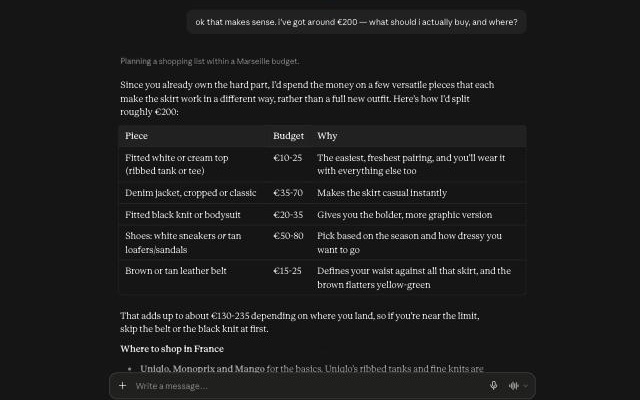
Do AI assistants know your location? Marseille came up in 6 of 15 cold French sessions.
In cold sessions, Laura says nothing about where she lives. Our French sessions ran through a VPN that exits in Marseille. Laura's persona lives in Lyon, and the prompts never name either.
Two more answers, and what we can't tellShow less
In Marseille, Les Terrasses du Port, Centre Bourse and Rue Saint-Ferréol have most of those chains in one trip.
Since you're looking to try them on tomorrow, Sunday 11 October, I'd focus on shops in Marseille rather than relying on delivery.
It's not always right, and we can't tell how they do it. Gemini put Laura in Larnaca. In Cyprus some assistants named Limassol, her persona's city, which earlier test chats in the account may have leaked. For a shopper this cuts both ways: useful when it's right, and confusing when an assistant sets out her shopping around a city she doesn't live in.
When AI shopping assistants find a good link: 33 of 52 first good links came after turn two.
- 9T1
- 10T2
- 4T3
- 11T4
- 4T5
- 13T6
- 1T7
- 36Never
The bumps at turns 4 and 6 are where the script asks again and reports a problem. By turn two, only 19 of 88 sessions had a good link: about one in five. If real conversations last two or three turns, that's closer to what most shoppers get. Our follow-ups are scripted and come in the same order, so this describes when good links appear, not what causes them.
Do later links get better?Show less
Later links aren't better links, either. The share of good links is 40% at turns one and two, 29% at turns three and four, 37% after that. Pushing back gets her more tries. And sometimes it gets her an apology and the same problem.
You are completely right—the M&S link pointed to the wrong domain entirely, and category pages aren't direct product links.
On the page The link had gone to msci.com, a financial company. The replacement was a home page with directions.
I opened the exact link I previously gave you, and it redirects to Next's general vest-top category instead of the individual product page.
Does telling an AI assistant who you are help? 41% fewer bad clicks, but a good link no more often.
| Cold | Introduced | |
|---|---|---|
| Links we could check | 230 | 166 |
| Good links | 71 | 68 |
| Bad links clicked before a good one | 99 | 58 |
| Sessions that found a good link | 27 | 25 |
We expected an introduction to make things better, and on success it doesn't: 25 of 44 sessions find a good link, against 27 cold. What changes is the road. She sees fewer links, so fewer bad ones. But pair by pair there's no clear difference: in 20 of the 35 pairs that differed, the introduced session had fewer bad clicks before a good one (p=0.5). Among sessions that found a good link, the median is 0 either way.
How each assistant reactsShow less
The assistants react differently. ChatGPT is the only one with a real gain, with about the same number of links and 43 good becoming 47. Claude halves its links and keeps its good ones. Gemini nearly halves its links and loses most of its good ones, from 16 to 7. The first link isn't reliably better: good in 14 of 44 sessions either way. Two things sit next to this result: the introduced session always ran second, and its introduction states her size and budget up front.
How to spot a bad AI shopping link: with no price in her currency, only 8% were good.
Some of what an assistant says tells you how far to trust a link. A link with a price in her currency was good 42% of the time. One with no price or another currency: 8%. Links described as being for her: 46%, against 17% for the rest. These hold when we resample whole sessions. They aren't causes, and the currency result is partly built in, since a shop abroad is rarely confirmed as reaching her. But they're usable: no local price, look twice.
- Price in her currency42%
- No price, or another currency8%
- Described as being for her46%
- Not described as for her17%
What you'd expect to help, and doesn'tShow less
Some things you'd expect to help don't. The first link in an answer is no better than the rest (36% against 35%): the top pick isn't the best pick. The five most-linked brands aren't clearly better than other shops (40% and 32%). And when “more links” helps, it's as more chances: sessions showing more links find more good ones, but only slightly better odds per link. The data report has the full list.
Would shoppers let AI buy for them? 109 of 147 say no, and 3 use it to finish a purchase.
Alongside the tests we asked 147 people how they shop for clothes and where AI helps. It's a convenience sample, 72% women from many countries, and 69 don't use AI for shopping at all. It can't prove a test result. It shows whether people notice the same thing, and they do. Ideas are what they use AI for most (29%). Finding the product is the step they rate lowest, narrowly (3.55 of 5).
- Yes9 · 6%
- Maybe29 · 20%
- No109 · 74%
In shoppers' own wordsShow less
“I don't recall finding a piece from an LLM's suggestion, however I definitely learned how to search for the right piece myself”
“All of the items, even though had my size as an idea, didn't have it available for purchase.”
“I will not let ai shop for me, it will take out all the fun and excitement of selecting and matching.”
Can contradictory product pages mislead AI assistants? Not proven yet, but worth digging into.
One more thread, and we're flagging it as only that. We didn't measure it across the 88 sessions, so this study neither confirms it nor rules it out. It's worth digging into.
What we saw on the pagesShow less
A page can disagree with itself. In our August pilot, one Next dress was titled “100% Cotton” while its composition listed 44% viscose, 44% cotton and 12% linen. Another was “Long Sleeve” in its title and “Sleeveless” in its attributes. A shopper looks at the photo and moves on. An assistant may read the fields and repeat them.
“In stock” can be wrong in the page's own data. Product pages carry data meant for software to read. In the pilot, a Lulus dress was marked InStock in that data with nine of its ten sizes crossed out. In the 88 sessions we noticed one clear case in passing: a Whistles page marked InStock with every size shown as out of stock. We didn't record this systematically, so we can't say how common it is.
If it's common, some of what looks like an assistant's mistake starts on the store's page. To test that, you'd compare what each page's data says, what the page shows and what the assistant said, at the same moment. We didn't capture that. The pilot pages aren't in any number here and may have changed since.
What AI shopping means for online stores: the chat points her somewhere, your pages still decide.
Two links in three failed her, and some of them point at stores like yours. Three things follow.
Assistants send shoppers to the wrong page.
Two links in three failed her: sold out in her size, men's, broken, or out of reach. Some of them point at stores like yours.
Make size and stock readable.
24 pages had her size in stock with no table to EU 38, and 43 more wouldn't open for our check at all. A shopper picks an M; an assistant that can't read your size grid can't tell her it's there.
The choice is still made on your site.
Only 3 of 147 shoppers use AI to buy. Whatever the chat suggested, the decision happens on your pages.
What e-commerce experts say about AI shopping: three experts answer three questions.
Before publication we shared the study with people who work in e-commerce, data and research, and asked them three questions. Their answers are below as they wrote them, with their permission to name them.
What is the most interesting or unexpected insight you found in this report, and why does it matter for the e-commerce industry?
“For me the headline result is the expected one. Only a third of links were buyable, and I’d have guessed something similar, because neither the models, nor the websites, nor shoppers are ready for AI purchasing yet.
What is interesting is how separate the two skills are. The assistants understood her taste almost every time, yet her size was often out of stock, and the study found the two are unrelated. Even telling the assistant her size barely changed anything. Taste comes from the model; stock comes from data the model can’t see. Real availability sits in a retailer’s backend, by variant and by market, and retailers have good commercial and security reasons not to put it all on a public page. So I read this gap as structural, not as a flaw a smarter model will fix. It matters because it shows what assistants are today: a strong tool for ideas and discovery, and a weak one for the purchase itself.”
“What struck me as a researcher is how well the two methods agree. Shoppers rate “finding the product” as the weakest step (3.55 of 5), and the live check shows why: only 35% of links were buyable. When what people say and what you observe line up this closely, the finding is solid. The problem isn’t how shoppers perceive AI; it’s real.”
“The assistants nailed Laura's taste almost every time: her palette on 98% of pages, her no-gos avoided on 96%. But only 58% had her size in stock, and the two were basically uncorrelated. It seems that AI has largely solved "understanding what the customer wants", or at least getting very close to it.
What it hasn't solved is "knowing what's actually available right now." That's not really a model problem. It's a data problem, and much of it sits with retailers.”
Which finding in this report do you think deserves more attention from e-commerce businesses, and why?
“I work on expansion into new markets, and this is the lesson I’d take from it: AI assistants are now a discovery channel alongside search and social, and visibility in them doesn’t come by default. It takes local pricing, clear delivery information, accurate stock and pages that automated systems can open. SEO teams have already started on this. It will be hardest for small businesses, who risk not being found at all, though the same AI tools can help a small team catch up. The time to start was yesterday.”
“Only 3 of 147 shoppers let AI complete the purchase — the decision still happens on the brand’s own pages. That’s good news for retailers, but it raises the bar: if you don’t know what your customer came for, the chat won’t tell you, and she won’t tell you twice.”
“The contradictory product pages. A title says "100% cotton" while the composition says 44% viscose. Structured data says "in stock" while every size is crossed out. A person glances at the photo and moves on, but an AI reads the fields and repeats them confidently. So some of what we call AI hallucination may actually start in our own catalogs. Most retailers have never audited their product data as if a machine were the main reader. It's time to start.”
Based on your experience, what is the biggest challenge e-commerce businesses will need to address to stay competitive in this changing landscape?
“Trust first. In the survey, 109 of 147 shoppers wouldn’t let AI buy for them, and only 3 use it to complete a purchase. When an assistant says “in stock” and the page says sold out, that reluctance is earned. The same goes for personalisation people didn’t ask for: in the study, assistants placed the shopper in a city she had never mentioned. People need to know what data is used and to control it.
The second challenge is capacity. Teams now have to run brand, classic SEO and AI visibility at the same time, while still improving the on-site experience, because the purchase decision still happens on the store’s own pages. That means more parallel work: structured product data, size tables per market, a deliberate policy on AI crawlers, and tracking AI referrals as a separate channel. Adopting AI for its own sake isn’t the goal; it has to solve a real problem for the customer.”
“Telling assumptions about customers apart from evidence. One assistant said “in stock” with confidence and was wrong in 8 of 20 checked cases, and in research a confident wrong answer costs more than no answer at all. The brands that stay competitive will be the ones that test what they believe about their customers, regularly and in their own markets.”
“Being readable to machines while still winning the sale on your own site. Your catalog needs accurate, real-time stock, sizes and local pricing, because that's what assistants rely on. In eyewear, that means fit and prescription data. But as the report shows, only 2% of shoppers actually buy through AI, so the decision still happens on your page.
When someone arrives from a chat and lands on a sold-out item, that's a dead end at their moment of highest intent. This should be treated seriously: showing in-size alternatives right away, and giving clear local pricing and delivery.”
Limits of this AI shopping study: one run per cell, one shopper, free plans. A snapshot, not a ranking.
What it can't tell you: how much an assistant varies between runs, or how far model, plan, search backend, bot-blocking and location signals each matter. France and the UK ran on VPN exits, Cyprus on a residential connection, and the browser time zone was Cyprus throughout. Earlier test chats were visible in some accounts' history. We can't tell links that were invented from links that went stale.
Who ran it: ob.session sells on-site personalisation to online shops. The study is self-funded and no assistant vendor was involved. Sessions were run with Claude-based browser automation, which typed the scripted turns and captured the answers. Claude is also one of the assistants tested. The script, not the automation, chose every follow-up.
Sessions, scoring and counting rulesShow less
Each assistant ran each task in each country twice, which makes 90 sessions; 88 are here. Gemini's two Cyprus wedding sessions ran after the data freeze on 16 October. Sessions ran on free plans, signed in to one research account per assistant. Paid plans may behave differently. Claude showed Sonnet 5.5, Gemini showed 3.5 Flash-Lite in 9 of 10 French sessions and Auto elsewhere, and ChatGPT's model was recorded in only 5 of 30.
Every product link was opened on the live page from the shopper's country and scored on ten criteria. Three are pass/fail: a women's or unisex item, EU 38 in stock, delivery to her. The other seven are the brief, palette, fabric, no-gos, budget, delivery terms and her country's storefront. A good link passes all three and meets at least 8 of 10.
43 of the 439 links wouldn't open for us, behind a bot wall or a country gate. They look like product pages, so they're left out of every share. Links that lead to no product count as failed. A men's or children's page counts as that, even if it's also sold out. Some stores have letter or waist sizes and no table to EU 38. A shopper would pick M, or a 28 in jeans, so we count those in stock as her size: 24 pages. Counting only sizes a table confirms, the share of good links would be 29% (115 of 396) rather than 35%. One link's size stays unclear: a coat sized 1 to 4, with no comparison table found by us or by the automated check.
Download the data: the report in charts, and everything behind it.
Data report
The evidence in charts: every session on one grid, correlations, what goes with a good link, what made no difference.
PDF, 1 MB
Raw data
Every session, named item and link as three CSV files, 88 redacted transcripts, survey totals, and a script that recomputes the numbers in this study.
ZIP, 1.5 MB
Cite this report
Sukhova, K. (2026). 88 Shopping Sessions with LLMs: Only One Link in Three Is Buyable. ob.session, 24 November 2026. https://ob-session.com/research/ai-shopping